

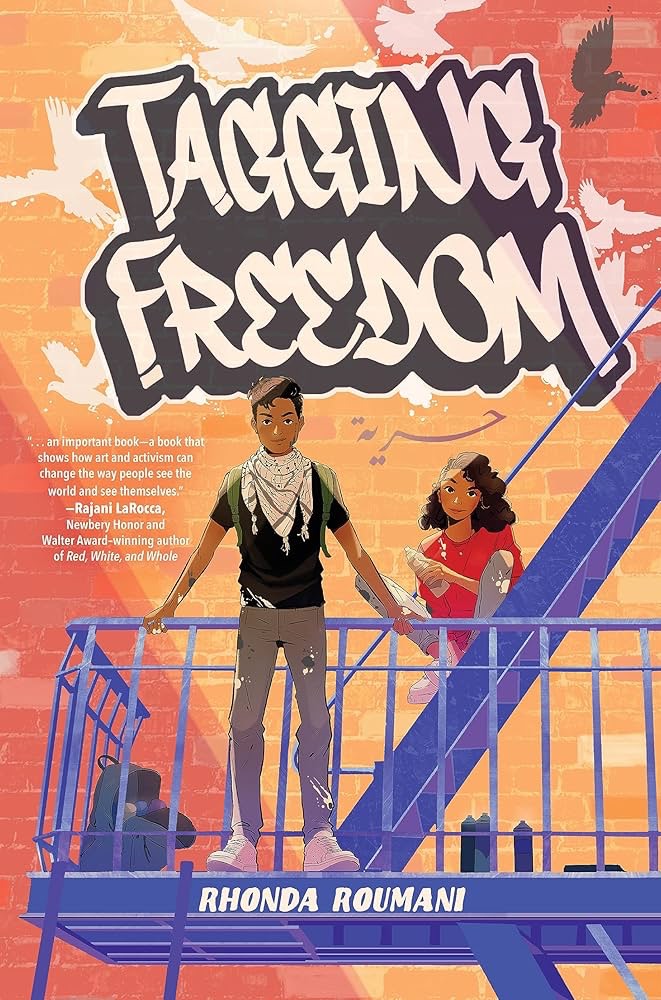
About a month ago, I was wandering through my local library, when my gaze landed upon Tagging Freedom. I was immediately hooked; and how could I not be, with a cover like that? And the story did not disappoint.
Tagging Freedom is a middle grade novel about two Syrian kids: Kareem and Samira. Kareem lives in Damascus, Syria, in the midst of a revolution. He and his friends have set up a sneaky little system to speak their piece in a world trying to silence them: graffiti art. Bold, powerful pieces, to speak out against the death of the innocent and their corrupt government.
Meanwhile, his cousin Samira has her own problems in her little town of Allansdale, MA. She’s the only Arab girl in her school, and she’s tired of standing out. So she joins the popular Spirit Squad, where her artistic abilities attract the jealousy of the popular squad leader.
But after Kareem is caught graffitiing by his parents, he’s sent to the USA to stay with his cousin, and their worlds collide. Kareem can’t believe how insensitive the people of Allansdale are to the revolution spilling through his country. When graffiti messages start popping up around their school, all eyes turn to Kareem, and Sam must make a choice. Stay quiet and fit in into the life she so desperately wants? Or speak out and band with her cousin and her country?
Tagging Freedom was slower paced than most books I read–rather than a setting in some galaxy far away, the majority of the story is set in the middle school of Allansdale. But it’s the kind of setting that’s simple in a way where you could imagine yourself in this situation, which speaks well to the message of the novel. Tagging Freedom is a novel about freedom, about finding yourself, about making a move for what you believe. I cared about the characters and wanted them to succeed, and Roumani does a wonderful job of coupling the high stakes of the war with the pain of kids wanting freedom in their lives.
One of my favorite things about this book is the immediate contrast between Samira and Kareem: Kareem is a wild rule-breaker with a fiery spirit and a thirst for freedom and justice. Samira is more tame on the surface–she’s a rule-follower, who paints inside the lines and tries to fit in.
I also enjoyed all the culture integrated into this novel. Arabic words throughout the book, and characters who use Arabic calligraphy, all the Arabic foods, and customs. Even a few scenes of the characters praying in traditional Arabic fashion.
In particular, there’s a scene where Kareem takes a moment to really pray for the first time in a while. He goes into the sujud position, which is a Islamic position for prayer where his forehead is touching the ground: a completely vulnerable position. I loved the emotion and vulnerability we got from such a fierce character, and how the author showed the importance of taking time to pray. In the scene, Kareem recognizes all the troubles in Syria and his current life that he can’t control–the emotions, the stress, the war. Bu in the midst of it all, he feels a quiet peace come over him. Something I think is a beautiful moment in prayer, that feeling when your life is spiraling out of control, there is someone higher who has everything in His hands.
Tagging Freedom also does a wonderful job of showing the struggle of being different and being yourself in a world that doesn’t accept it. With the struggle of Kareem fighting for freedom and keeping hold of himself in a new enviroment, contrasting with Samira’s struggle to balance her Arabic home and culture vs. the conformity of public school in a small American town. And it connects to one of the most important messages in the book: keeping hold of, and being proud, of your culture, even within a land trying to smother your fight and your roots.
This definitely is a middle-grade book, even though I somehow found it in the YA section of my library. We have the common tropes of quick crushes, figuring out life and social groups and mean popular girls… and a fair share of telling sentences and scenes where the emotion felt shallow. The ending was a bit lackluster; while it was still satisfactory, I would’ve loved to see a little bit more story or emotions from the characters.
But Roumani does a wonderful job of taking a typical story format–a new boy in town, in dual POV with a girl who just wants to fit into school–and pairs that with a story of freedom and embracing culture and your roots. And the characters accomplish that through bold, empowering graffiti art–a fun and inspiring twist.
I rate Tagging Freedom 3.5 out of 5 stars. It’s an invigorating read, but below my reading level. I highly recommend for ages 10 – 14, especially for anyone interested in activism, other cultures, and seeing kids their age fight for change.
Thanks for reading! If you have any books you’d like to recommend for my upcoming reviews, let me know in the comments! I always enjoy new recommendations 😀

 ZRise Writes